
LAST WEEK’S KEY FACTORS AND MAIN TRENDS
IN THE DEVELOPMENT OF THE SITUATION AROUND UKRAINE
(May 22–28, 2017)
I. Major-Profile Events in the Development of the Situation around Ukraine
The key event in the development of the world situation regarding Ukraine’s interests, was the summit of the “Big Seven” on 25–27 May 2017 in Taormina (Sicily Island) in Italy. The summit was demonstrative in terms of the first meeting of G7 leaders after the election of D. Trump the US President and E. Macron — President of France.
The summit discussed the most important global political, economic, environmental and security issues, including the situation around Russia’s military aggression against Ukraine. Following the talks, a Joint Communiqué was adopted, containing obligations of the parties to intensify the fight against terrorism and to increase openness of international trade. The participants also expressed willingness to impose new sanctions against North Korea in case if it does not stop the implementation of its missile and nuclear program, and against Russia — in case of Moscow’s further failure to implement the Minsk Agreements.
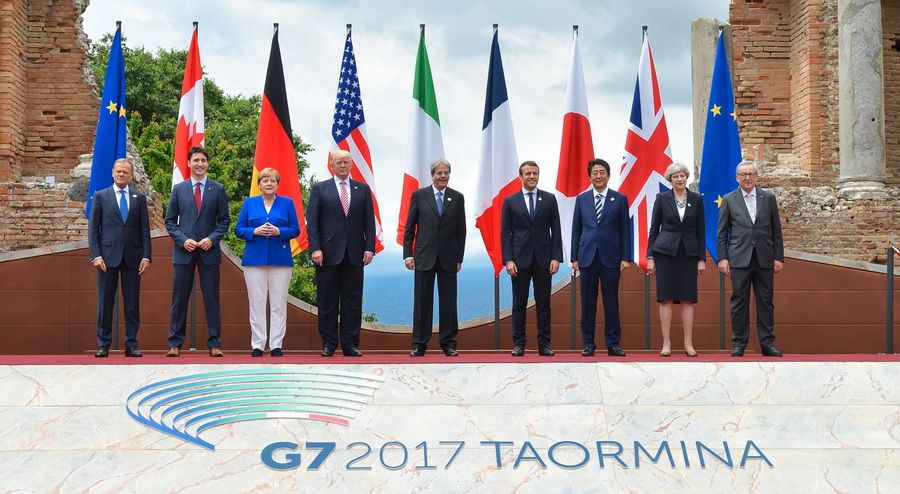 |
| Leaders at the G7 summit in Taormina |
So, the leaders of the “Big Seven”(including Moscow’s “strategic partner” — China) openly brought Russia into line with other “rogue states”, including North Korea. In this aspect the most illustrative was D. Trump’s assessment of the Russian Federation’s policy, which showed the leading countries’ real attitude to the Putin regime. Thus, according to him, Russia should be punished for the annexation of the Crimea and the provocation of the conflict in the Donbas. At the same time, D. Trump confirmed the transatlantic unity over the issue of sanctions against Russia and called on other countries to make Moscow implement the Minsk Agreements. At this, he emphasized that G8 format with Russia could be restored only if the RF changes its policy.
Before the G7 summit the above-mentioned issues had been also discussed during separate meetings of the US President D. Trump with the leaderships of the EU and NATO. At that, D. Trump reiterated the USA’s intentions to continue strategic cooperation with the EU and NATO. The main directions of the cooperation in the security sphere were called fighting terrorism, countering threats from Russia, settling the conflict in Syria, as well as increasing control over the flow of migrants to Europe. To this end, was announced NATO’s formal decision on joining the international coalition against “Islamic state”. Besides, the leaders of the USA, EU and NATO expressed a common position on maintaining the sanction policy towards the Russian Federaton and supporting Ukraine.
 |
 |
| Meetings of the US President D. Trump with the leaderships of the EU and NATO | |
The common position of the leaders of Western countries over the Russian issue caused the expected negative reaction from the Russian Federation. Thus, according to the presidential press secretary D. Peskov, attempts to isolate Russia and the pressure on it can only lead to further tension in international relations and destabilize the world. Besides, he once again rejected the West’s accusing Moscow of interfering with the situation in the East of Ukraine.
To counterweight such accusations, the Kremlin made an attempt to shift onto Ukraine the responsibility for maintaining the tension in the Donbas. Thus, referring to Ukraine’s refusal to fulfill the political part of the peace plan prior to solving security problems in the conflict zone, Russian Foreign Minister S. Lavrov accused Ukraine of “actual withdrawal from the Minsk Agreements”. At the same time, it is Russia who openly blocks the Minsk process, using all possible excuses. In particular, according to the Foreign Ministry Spokesperson М. Zakharova, “a ban on St. George’s ribbons in Ukraine stirs up hostility in the Ukrainian society and in fact prevents implementation of the Minsk Agreements”.
II. Russia’s Military Aggression against Ukraine
2.1. The East of Ukraine (the ATO Zone)
The evidence of the mentioned Moscow’s position was the failure of the Trilateral Contact Group to meet in Minsk on 24 May 2017, as a consequence of the destructive position of representatives of the “DPR” and “LPR”. In particular, they put forward unacceptable for Ukraine demands for amnesty of militants. Based on these demands, the leaders of the breakaway republics (de facto — Russia) stopped the exchange of hostages and prisoners.
However, the Russian-terrorist forces continued shelling positions forces ATO and peaceful settlements of the average intensity of more than 60 per day with the use of heavy weapons. The most tense situation recorded in Donetsk region (Avdiivka) on Svetlodarsk arc or near Volnovakha and Mariupol.
2.2. The Crimean Peninsula
As the socio-economic situation in the Crimea deteriorates, the Russian leadership is trying to distract people from internal problems by forcing another wave of anti-Ukrainian hysteria in the Peninsula. Like in the summer of last year, for this purpose Russia again uses the theme of “Ukraine’s subversive activities in the Crimean Peninsula”.
To give this issue more resonant character, May 24, 2017, in the Crimea were launched large-scale anti-terrorist trainings involving units of the RF FSB Special Task Center. In the training participate air and sea vehicles, special armoured vehicles and robotic systems for detecting and defeating terrorists.
 |
 |
 |
| Trainings of the Russian FSB in the occupied Crimea | ||
At the same time, to maintain its positions in the Crimea, Russia needs to spend more and more. Thus, annual expenditure from the RF state budget for these purposes is about 5 billion US dollars. For comparison — the annual budget spending on health care in Russia is 3–3.5 billion US dollars. At this, in 2017 these costs were reduced by 40 %.
2.3. Other Aspects of the Russian Federatio’s Actions against Ukraine and the West
In response to pressure from the West, the leadership of the Russian Federation continues the policy of intimidating the USA and Europe by the demonstration of military force. Thus, May 24, 2017, before the G7 summit in Italy, Defense Minister S. Shoigu spoke in the Federation Council on the state and prospects of development of Russia’s Strategic Nuclear Forces (SNF). According to him, today the Russian nuclear triad — Strategic Aviation, submarine fleet and Strategic Rocket Forces (RVSN) are by 60 % equipped with modern weapons. This has raised significantly the RF Armed Forces’ combat potential and ensured their parity with NATO.
According to him, at present already 9 Regiments of the RVSN have been rearmed with new missile complexes “Yars” (RS-24; mobile complexes that have increased capabilities of breaking through the enemy’s AD system), and by 2021 another 8 Regiments will have been re-equipped. Within the same period of time they are going to adopt a new intercontinental ballistic missile “Sarmat” (RS-28), which will replace the missile complex “Voyevoda”(RS-20A) of Ukrainian production.
In early 2020 Russians are going to begin serial production of modernized strategic bombers Tu-160M2 able to strike enemy ground targets without entering a zone of its Air Defense system. They will also continue modernizing strategic bombers Tu-95MS and Tu-160.
Besides, S. Shoigu pointed out the plans for the adoption of new anti-aircraft missile systems S-500, multi-tactical aviation aircrafts of the fifth generation T-50, and precision attack systems of land, sea and air deployment. In particular, in the last year alone, the Armed Forces received 40 carriers of precision weapons and 180 long-range cruise missiles. Referring to this, S. Shoigu stressed the “Russian Federation’s ability to compete the West”.
 |
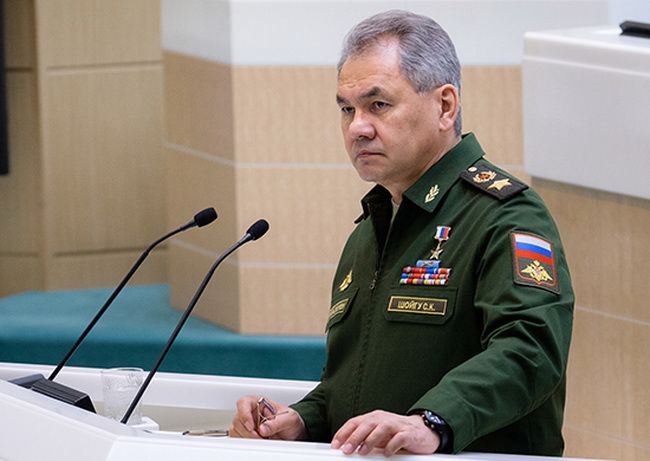 |
| Russian Defense Minister S. Shoigu at a session of the Federation Council, May 24 | |
Within the framework of the practical implementation of the RF leadership’s plans to improve offensive capabilities of the Armed Forces, strike military units are being formed. In particular, as part of the the 76th Air-Assault Division (AAD, with HQ in Pskov) of the Airborne Forces of the RF Armed Forces, a Regimental (on the basis of the 104th Air-Assault Regiment) and a Battalion (as part of the 234th Air-Assault Regiment) Strike Tactical Groups were created. These units are fully staffed and equipped/armed. The 76th AAD is designed for operations on the North-Western (Baltic) strategic direction and will take part in the “West-2017” in autumn this year.
At the same time, a Separate Air-Aassault Battalion of the 76th AAD is being formed in the Crimea. The Battalion will be deployed near Feodosia and will have become operational before December 1, 2017. On the basis of this Battalion by the end of 2017 in the Crimea there will have been deployed the 97th Air-Assault Regiment (the third in the 76th AAD).
Besides, in the Army of the RF Armed Forces, they continue to create special task reconnaissance companies (the decision on this was made in 2016). The task of these units is to search for certain objects in the enemy’s rear and to report their coordinates for further use of the “Iskander-M” and long-range “Uragan” systems. In each Combined Arms Army and Tank Army, a special task reconnaissance company is planned to be created. As of today, such companies have been formed in the 49th and 58th Combined Arms Armies of the Southern Military District.
Against this background, as the summer trainings in the RF Armed Forces begin, the measures for operational and combat training will intensify. In particular, last week were conducted: joint Russian-Belarusian exercise on electronic warfare in Belarus; tactical exercise of the Northern Fleet with mastering the tasks of air defense by a detachment of warships; exercise of a group of ships of the Russian Navy in the Mediterranean with launching cruise missiles.
Russia also continues provocations against the Baltic countries. May 22, 2017, three warships and a submarine of the Baltic Fleet were at a distance of 6 nautical miles from Latvia’s border.
III. Ukraine, International Organizations and Leading Western Countries
The growth of the military threat from Russia causes an adequate reaction of Western countries and international organizations that strive to improve European security.
3.1. International Organizations
NATO. The NATO continues the complex of maneuvers and exercises on practicing repulsing Russia’s possible aggression against NATO’s member and partner countries in Europe. At this, taking into consideration the current situation, special attention is paid to the Baltic and Arctic areas.
Thus, till May 25, 2017, NATO’s exercise “Kevadtorm-2017” (“Spring Storm-2017”) were taking in Estonia and in the Baltic Sea. Besides, last week in the Baltic region there began: NATO’s naval maneuvers “Baltops” (involving over 40 ships from 14 NATO countries); exercise of Poland, Lithuania, Latvia, Estonia and Belgium’s Navies “Baltic Fortress-2017” (mastering receiving NATO’s troops arriving by sea); exercise of the Command and Control Centre of Excellence of the Alliance — “Steadfast Cobalt” (held in Lithuania with subunits of the NATO’s Response Force).
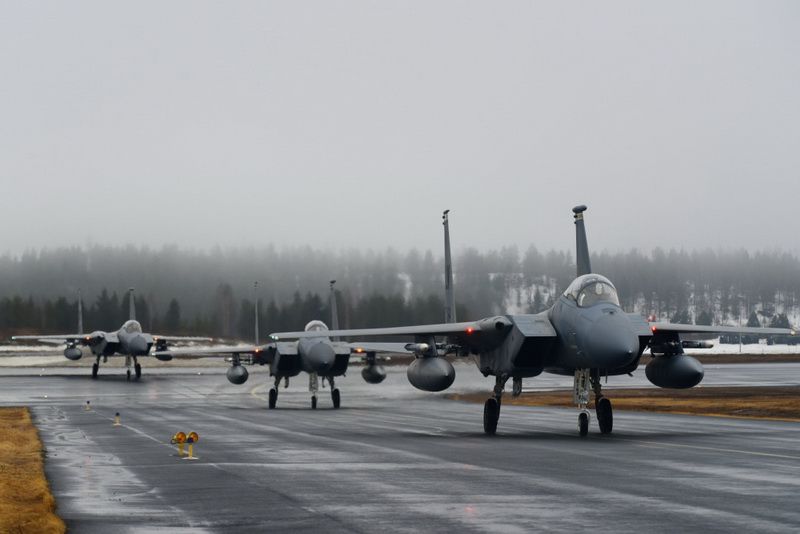
At the same time, in the Arctic region there was an “Arctic Challenge Exercise-2017” with more than 100 warplanes from Finland, Norway, the Netherlands, Belgium, Britain, Canada, France, Germany, Switzerland and the United States. They mastered joint actions in the conflict zone in the Arctic region. The main point of concentration of the participants’ forces was the air base Bodø in Norway. Involved were the F-16 (Norway and Belgium), F-15 (the USA), Tornado GR4 (the UK), Mirage 2000 and Dassault Rafale (France) and American strategic bombers B-52, Airborne Warning&Control System (AWACS) aircrafts and refueling aircrafts KC-10A.
 |
 |
 |
| Arctic Challenge Exercise-2017 | ||
It is also pointed out that the intensity of flights of the US reconnaissance aircrafts in the Baltic and Black Sea regions, as well as near Russian bases in Syria and near the naval group of Russia’s Navy in the Mediterranean. There are two or three such flights daily, including with use of patrol anti-submarine aircrafts of the US Navy P-8A Poseidon and AWACS aircrafts.
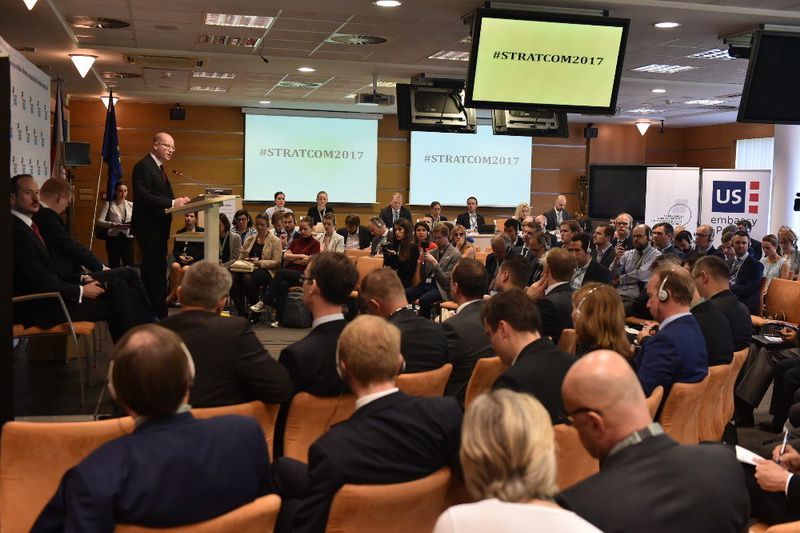 |
| StratCom Summit 2017 in Prague, Czech Republic |
The European Union. Against the background of NATO’s intensifying its measures to enhance military security in Europe, one of the main directions of the EU’s efforts to contain Russia is counteracting Moscow’s information expansion. Thus, last week in the Czech Republic was held an international conference on the Kremlin’s interference with the presidential election in the USA and EU. The conference was organized by the “European Values” think-tank, with the assistance of the Czech/EU Centre Against Terrorism and Hybrid Threats. The official partners of the event were NATO, the European Commission and the US and UK Embassies in the Czech Republic.
The conference pointed out that Russia conducts a massive information campaign to change to its benefit the politics of the USA and EU. Due to this, the main threats from Russia is Moscow’s actions to strengthen its influence in the information space of western countries and the actual establishment of control over the media in former Soviet republics.
Commenting on the issue, NATO Secretary General J. Stoltenberg gave a positive assessment of the Ukrainian leadership’s decision to block Russian online services and social networks on the Ukrainian territory. According to him, this decision is a necessary step in ensuring information security of Ukraine, not a violation of freedom of speech in the country.
3.2. Leading Western Countries
 |
| Resolution of the Washington State’s Senate on recognition of Holodomor of 1932–1933 in Ukraine as genocide |
The USA. The USA’s parliamentary circles have confirmed their solidarity with Ukraine. In this regard, illustrative was the decision of Washington State’s Senate on recognition of Holodomor of 1932–1933 in Ukraine as genocide. This decision was for the first time in the USA was legislated.
In the USA there continues the political scandal over D. Trump’s ties with Russia. Thus, according to the influential American “The New York Times”, the US intelligence has compelling evidence of close relations of the head of the presidential campaign P. Manafort and former adviser to US President M. Flynn with Russian special services. It was with their help that Moscow tried to change Washington’s attitude to Russia.
However, under public pressure the White House senior adviser, son-in-law of US President J. Kushner gave consent to cooperate with the FBI in the investigation of this matter. Thus, opponents of the US President is getting more possibilities of putting pressure on D. Trump in the interest of preventing a change in its policy in favor of Moscow.
 |
| The Concept of Defense of the Republic of Poland |
Poland. NATO’s position with regard to Russia has been fully supported by Poland, which remains one of the most active members of the Alliance. Thus, according to Poland’s new Defense Concept (introduced in May 2017), Russia is the main source of instability in the region and is seen as the greatest threat to the Polish state. The reason for this is called Moscow’s aggressive policy, which is trying to strengthen its international position and regain control of the former USSR through the breach of international law, use of force and coercion against other countries and attempts to destabilize NATO and the EU. In this context, a special concern was expressed regarding Moscow’s threatening with the use of nuclear weapons. Given these circumstances, there is a real danger of Moscow’s inciting a regional armed conflict involving one or more members of NATO.
IV. Other Important Trends and Developments that Will Have an Impact on Ukraine’s National Interests
Hungary. In Central-Eastern Europe there continue the protests against the ruling political parties of populist orientation, including pro-left and nationalist ones. In particular, in Budapest and other Hungarian cities, the protests continue against the policy of the ruling Nationalist Party “FIDES” with a demand to stop the persecution of NGOs that protect the rights of refugees and to cancel the decision on the closure of the Central European University.
 |
 |
| Anti-government protests in Budapest | |
At this, the protests in Hungary, as well as in the Czech Republic and Romania, may be the result of the EU’s concerted actions to counteract Russia’s attempts to strengthen its influence in Europe. Thus, along with intensification of the opposition’s protests in Hungary, the European Commission and the European Parliament strengthen pressure on the Hungarian government headed by V. Orban, demanding to implement the EU’s quota on reallocation of immigrants and other issues.
 |
| Interview of I. Dodon to Europa Libera |
Moldova. Despite the declaration of the course of rapprochement with Russia, the new President of Moldova I. Dodon shows a tightening position against the self-proclaimed Trans-Dniester Moldovan Republic (TMR), supported by Moscow. Thus, according to I. Dodon (in his interview with radio station Europa Libera), Trans-Dniester will never get independence and will remain a part of Moldova. In this regard, one of Chisinau’s priorities was called the establishment of Moldova and Ukraine’s joint control over the Trans-Dniester section of the Moldovan-Ukrainian border (in accordance with the agreement between Moldova and Ukraine — by the end of this year). This would allow Moldova to substantially increase its influence on the TMR in terms of settlement of the Trans-Dniester conflict through the restoration of territorial integrity of the Moldovan state.
V. Major Trends in the Development of the Situation around Ukraine in the Future
5.1. Key Events and Trends that Will Be Most Important for Ukraine
The results of the meeting of the “Big Seven” (May 25–27, in Italy) as well as the High-Level Forum within the Chinese initiative “The Belt and Road” (May 14–15, in Beijing) show the establishment of a new system of the world order with the leading role of the three main geopolitical forces, namely the USA, the EU and China. It is believed that in the short and longer term they will be determining the situation in the world. However, despite some inconsistencies in that triangle, they have no fundamental antagonisms, which could lead to international or regional conflicts.
In this situation, Russia in fact is on the sidelines of the world civilization and turns into a regional country with limited influence. With this in mind, and based on the imperial mentality of Russia’s leadership, we should expect that the Kremlin will intensify actions to improve Russia’s role and importance in the world. In this respect, as before, Moscow’s main efforts will be aimed at restoration of its control over the former Soviet Union, which is the main prerequisite for the revival of the “new Russian empire”.
However, to date, Russia has actually lost opportunities to achieve goals of this kind by political and economic methods. Thus, using the absolute advantage of their potentials, the USA, EU and China keep pushing Russia out of its traditional zones of influence, and this process is actually irreversible. Evidence of this is the actual reorientation of Ukraine to the EU and of Central Asia to China, making impossible actual creation of the Eurasian Union.
These circumstances make Moscow’s policy even more aggressive, and all this is accompanied by the build-up of the Russian military capacity and the use of force to achieve the Kremlin’s foreign policy goals. As a result, the confrontation between Russia and the West and Ukraine will be getting sharper, which will lead to an increase in the threat of regional and global conflicts. In particular, quite a real reason for the next outbreak of the conflict may be coming into force of the Association Agreement between Ukraine and the EU, which means the completion of Ukraine’s withdrawal from the “gray zone”of Russian influence and its return to Europe.
5.2. Prospects for the Development of Events in the Conflict Zones in Ukraine
Because of the actual inefficiency of the Minsk Agreements, German Chancellor A. Merkel initiates a new meeting of the “Normandy Group”at the highest level in order to intensify the peace process. Last week, A. Merkel discussed this issue during her telephone consultations with the new French President E. Macron and President of Ukraine P. Poroshenko. At this, Ukraine’s partners were given full information about the situation in the Donbas, including about Russia’s violations of the terms of the peace plan. The parties agreed to meet in the nearest future.
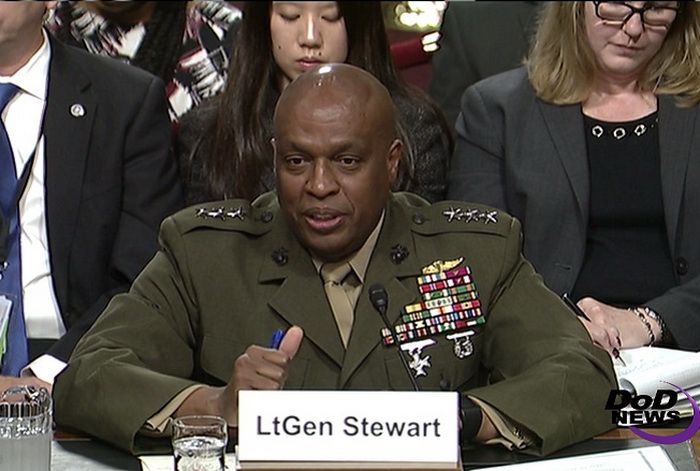 |
| Lieutenant General Vincent Stewart, Director of the Defense Intelligence Agency speaks during a Senate Select Committee, May 23 |
By the way, according to the Director of the U.S. Defense Intelligence Agency Lieutenant General V. Stewart’s statement before the US Senate’ Armed Services Committee, in the short and medium term, Russia will not go to implementation of security arrangements of the Minsk Agreements. So, the political provisions of the peace plan providing for the holding of elections in the “DPR”and “LPR” and giving them special status within Ukraine will not be implemented either.
Besides, the statement points out that Russia continues actions to further build up its groups of troops on both, the European and Ukrainian, directions. This leads to a conclusion that the Russian Federation’s leadership will expand the armed aggression against Ukraine. At the same time, the constraining factor for the Putin regime is Western sanctions that force it to be limited to supporting local fighting of the parties along the front line.
A similar opinion is shared by a number of Russian experts, who do not exclude the possibility of Russia’s intensifying the armed conflict in the Donbas in order to provoke Ukraine to respond. This way Russia will try to get the “evidence”of Ukraine’s violations of the Minsk Agreements and thus will try to shift the responsibility for the continuation of the conflict.
5.3. Other Important Events that Will Influence Ukraine’s Interests and Security
On Monday, May 29 2017, Russian President V. Putin will visit France. According to French President E. Macron, he intends to conduct a “demanding dialogue ” with the Russian President on the situation in Ukraine and Syria.
E. Macron will receive V. Putin in the Great Trianon Palace in Versailles near Paris, as part of the opening of the exhibition dedicated to the 300th anniversary of Franco-Russian diplomatic relations. Earlier, E. Macron said that after the summit of the G7 leaders, he plans to meet in the “Normandy Format” on the situation in Ukraine.
At a regular meeting on Tuesday, May 30, 2017, of the “Normandy Four” at the level of Deputy Foreign Ministers in Berlin, Russia will be represented by the State Secretary — Deputy Foreign Minister of the Russian Federation G. Karasin.
It is worth recalling that Russia did not participate in the previous meeting of the Representatives of the “Normandy Four” Foreign Affairs Ministries on 24 March 2017, in Paris. According to independent experts, in fact, at that time, Russia was trying to disrupt the next “Normandy meeting” in Paris, refusing to take part in it, since Moscow did not want to explain its position on a number of problematic issues in the negotiations.
At the same time, Russian President V. Putin, like always, uses the period between the elections in France and the FRG to make a “pause” in the work of the “Normandy Four”. Experts are not without reason wondering: What for does he need that pause and do Europe and the USA see what he is doing?
May 30 2017, the Senate (Upper House) of the Parliament of the Netherlands will be voting on the ratification of the EU-Ukraine Association Agreement. A positive result of voting would mean a final adoption of the document by the European Union. Previous discussions of the Agreement in the Senate of the Netherlands on May 25, 2017 showed that the document was supported by most of the Dutch Senators.
Along with this, in the nearest future of great importance for Ukraine will be the visit to our country by NATO Secretary General J. Stoltenberg and members of the North Atlantic Council (July 9–10, 2017 — on the occasion of the 20th anniversary of the Charter on a Distinctive Partnership between Ukraine and NATO) and the EU-Ukraine summit on 13 July, 2017.
In the course of these activities the participants will discuss cooperation between Ukraine and NATO and the EU and the situation in the conflict zone in the Donbas. These planned meetings confirm NATO and the EU’s support to Ukraine, as well as recognition of the role of Ukraine as an outpost of Western civilization in deterring Russia’s aggressive policy.

